Chapter 4: The Zanardelli-Giolitti Government, 1901–1904
Key figures
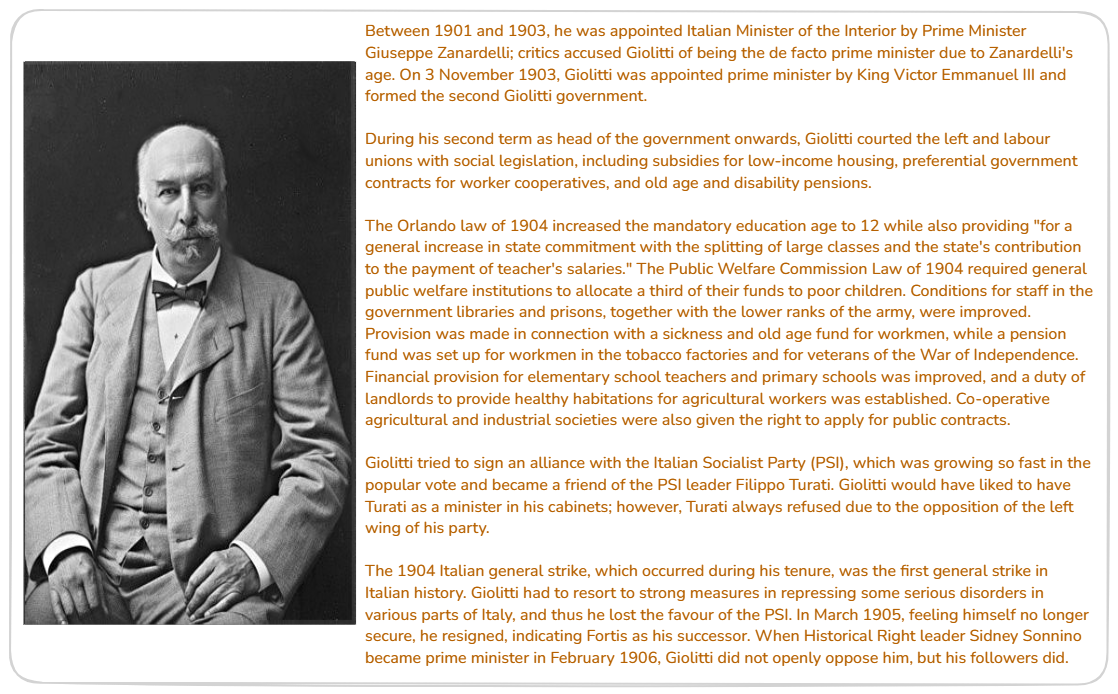
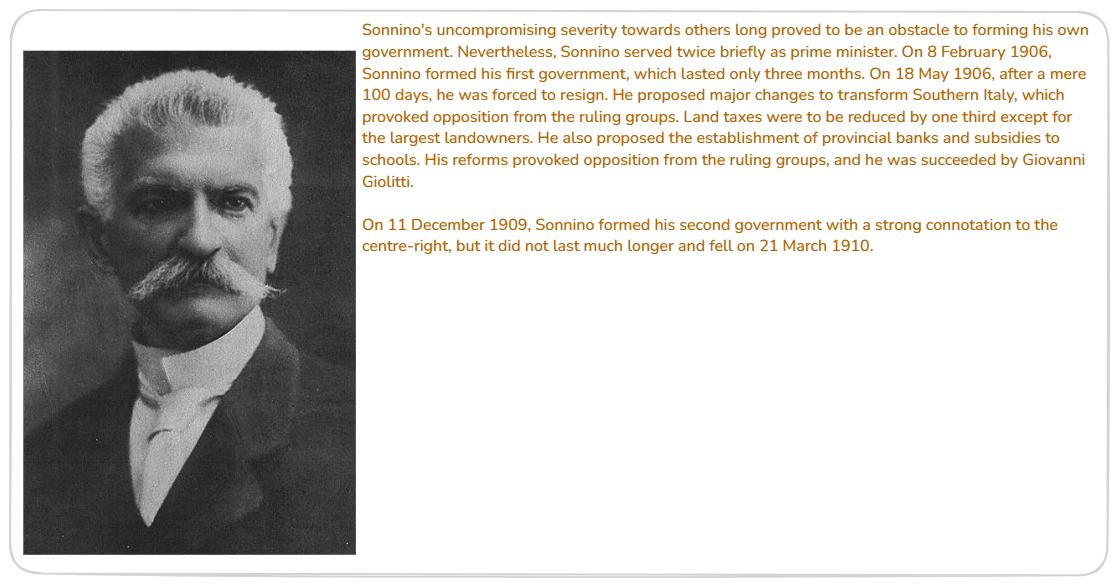
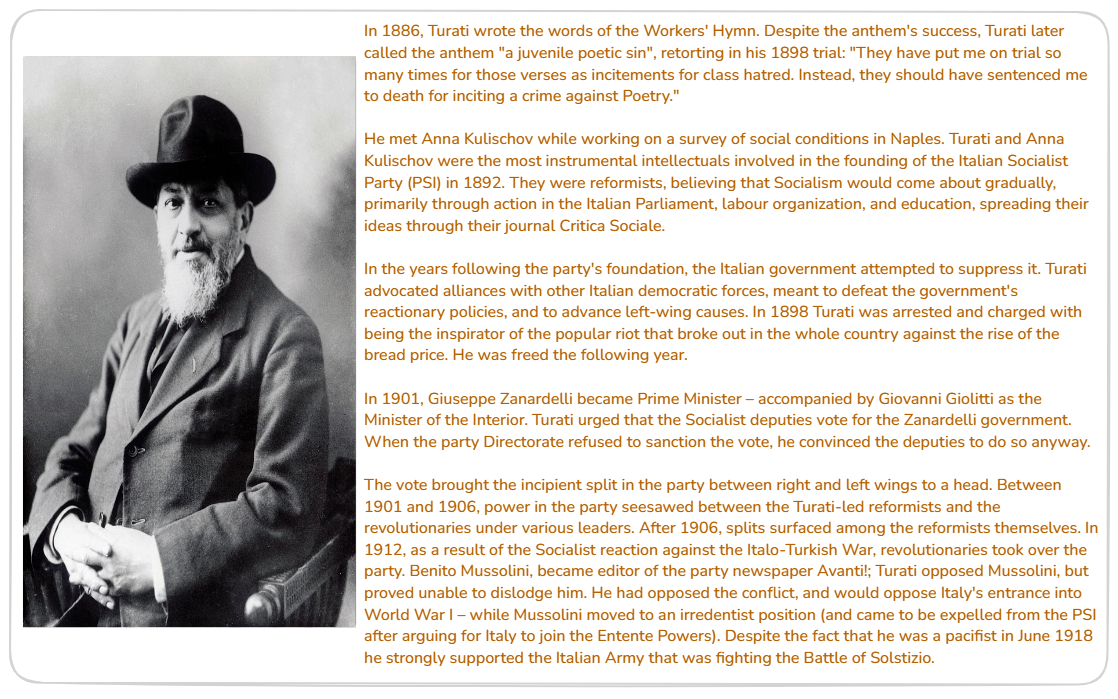
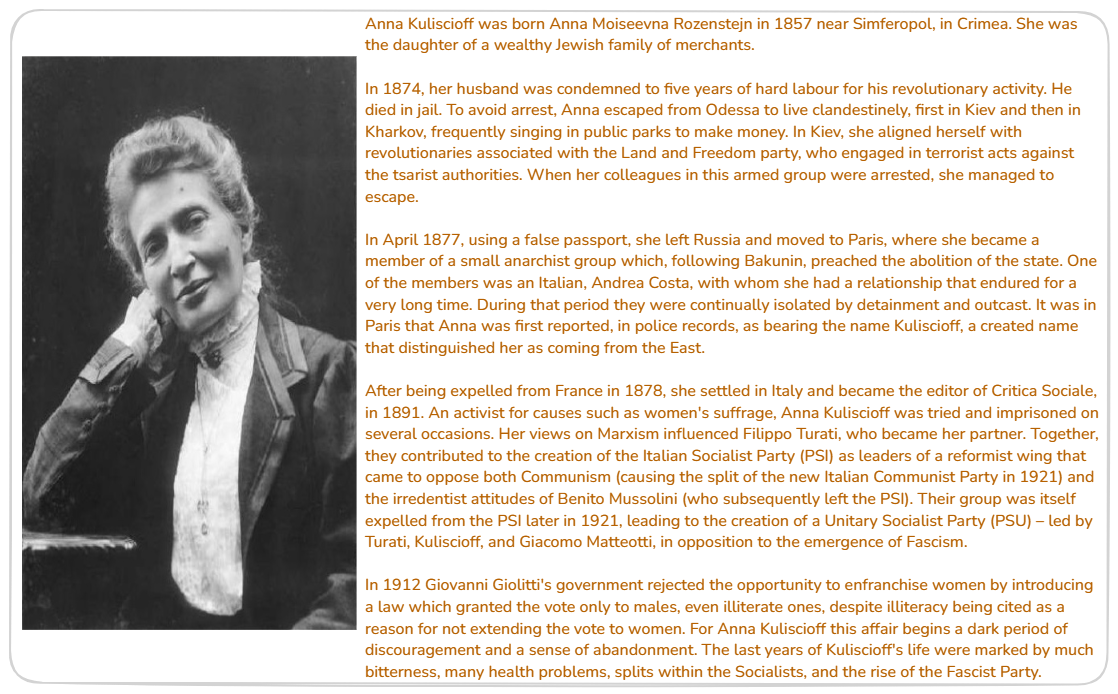
The New Zanardelli-Giolitti Government
The Zanardelli-Giolitti government that took office in February 1901 brought Giolitti just fame as a liberal reformer. As interior minister, his handling of the strike wave that gripped Italy in 1901 symbolized a new course in Italian politics. Labor organizations and collective bargaining in the private sector were henceforth tolerated by the government. Troops were not automatically called in to break strikes, although the right of nonstrikers and scab labor to work was protected. Politically the Socialist Party and the trade unions became subordinate negotiating partners within the Giolittian system.
Giolitti again revealed a sure hand in directing the bureaucratic apparatus of the state, but the context was very different from 1892–1893, when he was a junior partner to Giuseppe Zanardelli. Far more than the elderly Zanardelli, Giolitti understood how to realize his vision for the Liberal Party in competition with socialism and clericalism, but the new government broke with the past more over its interpretation of existing administrative procedures than over the initiation of fundamental reforms, such as equalization of tax burdens and cuts in the military budget. If the old structures of the liberal state remained in place, Giolitti gave them new efficiency and vigor.
The parliamentary situation in 1901 made any ambitious legislative agenda difficult. The new cabinet took power in a Chamber of Deputies that had been elected under the Pelloux government. The political class had not yet changed its attitudes in any fundamental way. But the new monarch, Vittorio Emanuele III, no longer believed that, Sidney Sonnino responded to the mood of the country.¹ The Zanardelli-Giolitti combination was also helped by the relatively benevolent attitude of the Marchese Antonio di Rudinì and Luigi Luzzatti, who made it known that they would offer only token opposition to the new ministry.² For his part, Giolitti had always been sensitive to the need to cultivate good relations with both Luzzatti and Rudinì. His open door to the right, designed in part to keep the conservative opposition from coalescing, was as important as the approaches to the Socialists and Radicals.³
The support of the Estrema also strengthened the new government’s hand. On February 4, over the objections of the Revolutionary Left and out of fear of Sonnino, Filippo Turati brought the Socialist parliamentary delegation behind the government. Carlo Romussi, the editor of Il Secolo, assured Giolitti of the support of most Radicals.⁴ Despite the unity of the left, Giolitti recalled that Zanardelli almost abandoned the mandate because of difficulties in filling the foreign ministry and other key positions. He warned Zanardelli that, having renounced the mandate to form the government in 1893 over much the same problem with the foreign ministry, he would be politically ruined if he failed again.⁵
In the end, the Zanardelli-Giolitti government was the usual coalition of liberal left and moderate factions. The conservative Giulio Prinetti joined as foreign minister with Giolitti, who in 1892 had been the target of Prinetti’s La Fanfulla. General Carioliano Ponza di San Martino and Admiral Enrico Morin, who held the War and Navy ministries, respectively, in the previous government stayed on. But the core of the government was a coalition between Giolittians and Zanardellians. The prime minister’s faction received key positions: Francesco Cocco-Ortu at Justice and Nunzio Nasi at Public Instruction. Giolitti got the interior ministry and Tancredi Galimberti became minister of posts. This alliance posed some problems. Carlo Romussi had to reassure Giolitti that his undersecretary, the Zanardellian Scipione Ronchetti, was not there to spy on him.⁶
Zanardelli was a Risorgimento liberal whose positions were shaped by the long dispute with the Catholic Church. He was certainly sincere in 1887 when he pronounced himself in favor of a reconciliation between church and state, but the Freemason Zanardelli viewed the power of the church as a threat to liberty. When he joined Rudinì’s government in 1897, he treated clericalism and socialism as equal dangers, and after the May riots he dissolved clerical organizations along with those of the Socialists.⁷ Giolitti was less concerned about the issues that agitated the Risorgimento generation, and his new course was going to be as much an opening to the Catholics as to the left. Unlike Zanardelli, whose base was in Brescia, a part of Lombardy bordering on the Veneto where the Catholic forces were powerful, Giolitti enjoyed good relations with the local Catholic clergy. He was never a Freemason, nor had he ever been identified with issues, like divorce, that created friction between church and state. ==Though Giolitti understood that the Liberal Party could lose its primacy to the twin threats of socialism and clericalism, his solution was not the formation of a modern, liberal mass-based movement (nonexistent outside of England and the United States in any case) to counterbalance Socialists and clericals but, rather, co-optation of parts of both rival mass movements through political and economic concessions.==⁸
Giolitti’s positions had not gone unnoticed during the 1898 crisis. The Vatican’s Osservatore romano made it clear in a series of editorials in the wake of the 1898 repression that the Catholics posed no threat to the social and economic order, but that liberalism would be unable to cope with the danger from the extreme left. However, in a generally negative editorial on the bankruptcy of liberalism, the paper noted that Giolitti represented something distinctive: a liberal politician who admitted the need to ease the tension between church and state.⁹ As the new government was being formed in February 1901, the Osservatore romano contrasted Zanardelli, a typical representative of Masonic anti-clericalism, to Giolitti, who had been more involved in economic problems. But the Osservatore romano questioned how a government committed to extreme liberty could handle the disorders and strikes that were gripping Italy in early 1901.¹⁰
The Strike Wave of 1901
The Vatican was correct that the immediate problem facing the government involved public order. Giolitti moved with great incisiveness to confront over 1,671 strikes involving 420,000 workers in 1901, in contrast to only 410 strikes and 43,000 workers the previous year.¹¹ Although labor agitation dropped off after 1902 and continued on a reduced level from 1903 to 1905, then peaked again in 1907, strike activity for the entire 1901–1914 period was the highest of any of the major European countries, with numerous strikes in the agricultural sector further accentuating Italy’s unique position.¹² The right to strike was protected by articles 165 and 166 of the Zanardelli code of 1889, which criminalized work stoppages only when accompanied by threats of violence. Giolitti had long argued against the need for further legislation against peaceful strikes. Any disorder during strikes could be considered to have been caused by marginalized delinquents who would then be prosecuted under common criminal statutes, even when the offense was obviously political in nature.¹³
The strike wave of 1901 involved industrial and agricultural workers and extended from the private to the public sector. Giolitti established a few general rules that he imparted with extreme vigor to the prefects. First, the government would remain neutral under the following conditions: that the strikes remain peaceful, that nonstrikers not be stopped from working, and that public services not be interrupted. When threatened with a strike in the state-run tobacco factories, Giolitti instructed the prefect of Milan to ensure complete freedom to work and to turn any hint of a strike over to the courts for criminal proceedings; in case of an actual strike, management should consider closing the factory. In a second incident in 1903 he told his undersecretary, Ronchetti, to expel all workers without legal residence from Rome and to refuse to negotiate with the tobacco workers until they ended the general strike. Once the strike was over, however, Giolitti asked Finance Minister Paolo Carcano to dismiss the director of the Rome tobacco factory, who seemed bent on provoking a new strike with unreasonable disciplinary measures.¹⁴
Even harsher treatment was reserved for telegraph workers in Rome. Giolitti ordered that they be immediately replaced by strikebreakers, that no public demonstrations be allowed in favor of the strike, and that strikers be expelled from Rome if they lacked means of support. Similar actions would be taken in Milan if the strike spread. Threats to deport nonresident strikers from the city and offers of full protection for replacement workers were also used in a streetcar strike in Livorno.¹⁵ Rail strikes received similar treatment. Giolitti telegraphed the prefects of Genoa and Bologna to inform them that he had heard rumors that a strike was planned. ==He instructed the prefects to plant agents so that they would know immediately when an order for a strike was given.==¹⁶
However, in private disputes prefects were urged to intervene promptly with the parties rather than allow the situation to develop into a strike. Concessions that would have been granted after the strike anyway were better offered immediately: “Experience teaches that management waits to make concessions until after the strike, conceding at that point what would have been sufficient to avoid it.” Thus they always encourage new strikes.¹⁷
Giolitti applied a second rule. The government had to have more than sufficient force on hand to meet any threat of violence. Strikes were likely to get out of hand more rapidly in the absence of state power. But the mobilization of police power was not easy. On taking office, Giolitti found the national Public Security police woefully shorthanded. The entire force of Pubblica Sicurezza agents in 1901 amounted to 6,500 men, of whom 1,000 each were stationed around Rome and Naples, 600 in Milan, and 450 in Palermo, with only about 3,500 left for the rest of Italy. In his first budget Giolitti requested 1,000 additional agents and further increases in staffing for the police bureaucracy.¹⁸ Even with these increases the government was forced to rely on the military. Giolitti constantly exhorted his prefects to ensure beforehand that they had sufficient military force on hand.
Third, Giolitti used contacts in the labor movement to convince the union leaders to accept reasonable offers and to limit strikes to economic issues. A corollary was that the prefect should make clear to employers that they could not expect to avoid negotiations with the unions by having the government aid them against strikers.
The key to the application of these rules was the prefect, who acted as Giolitti’s agent. Astute prefects adjusted rapidly to Giolitti’s new dispensation. Genoa had been a focal point of worker agitation that brought down the Saracco government. Prefect Camillo Garroni had suppressed the Camera del Lavoro, but Garroni, one of Giolitti’s most able prefects, understood the new policies. When sympathetic dock workers in Genoa refused to unload cargo shifted to that port from Marseilles, where another strike was going on, their refusal threatened to spread to other Italian ports. Giolitti did not automatically take the side of the employers. Instead, he tried to involve local Socialist leaders while insisting that the government would tolerate no interruption of essential services. Following up on a request from the secretary of the Labor Chamber of Genoa, passed on to the government through the Republican deputy from Genoa, Eugenio Chiesa, Giolitti instructed Garroni to see to it “that ships do not make port in Genoa or to convince the Genovese workers that any delivery will not work to the disadvantage of the Marseilles workers.”¹⁹ Giolitti also instructed the prefect of Palermo to do all in his power to end the sympathy strike by convincing the workers that they could gain nothing by blocking commercial traffic in difficult economic times.²⁰ Using the line of communication with the unions that Chiesa offered, Giolitti further instructed Garroni to make clear “how much damage any disorder would do to the working class.”²¹
While pressing the workers to remain flexible and peaceful, Giolitti informed the shipowners that they could expect a negative response if they asked for the military to protect and man their ships. The owners were warned of the risks of provoking a general strike: “It is not reasonable that through the obstinacy of some shipowners a general strike that would have the most serious consequences, especially for the working classes, is provoked.” Giolitti also pressed the Labor Chamber to avoid a general strike that would force the government to become involved: “Obviously government could not permit that unloading of fats and coal necessary for the food supply of Genoa and provinces of Upper Italy and for the industrial life be suspended.” And he successfully contacted Senator Erasmo Piaggio, the head of the major shipping company Navigazione Generale Italiana, to appeal for the resumption of negotiations.²²
Direct pressure on management did not always work. The Orlando shipyards in Livorno faced an exceptionally bitter and prolonged strike after it fired 100 workers and reorganized its mechanical sector. Although Giolitti had the able Angelo Annaratone in Livorno, little could be done to stop the Orlando family from threatening the complete closure of the shipyards.²³ When the increasingly desperate workers threatened violence, Giolitti instructed Annaratone “to please act to persuade the leaders of the working class to consider the serious damage that they can produce with their action and the consequences that will come of it.” In the end, the government found itself forced to defend the rights of property even when the company seemed unreasonable. Giolitti warned that if the Orlando yards closed, “the government would have no means whatsoever to oblige Orlando to reopen it.”²⁴
Agricultural Strikes
More dangerous, from the government’s point of view, were the agricultural strikes. Almost overnight rural Italy exploded into action against low salaries and terrible working conditions on the land. Two additional factors complicated the situation. First, landowners, powerfully represented in parliament, raised the specter of social revolution. Second, the long tradition of government violence against the peasants made Giolitti’s ideal of neutrality more difficult, especially when the landowners used strikebreakers whose right to work Giolitti was pledged to protect. To deal with the rural unrest, Giolitti relied on the intimidating use of overwhelming force. Prefects would never be blamed for requesting too much force but ran the risk of a career-ending rebuke if they mobilized too little.
Giolitti’s starting point was that the strike wave was a long overdue reaction against excessively low wages and, if held within reasonable limits, posed no threat to the state: “If this is the case, it would be useless and perhaps impossible to oppose such a movement. Therefore the action of the government must tend to regulate it, acting in [such] a way that the demands of the workers are held within reasonable limits and that the landowners examine them with benevolence and with the disposition to accept them when they are just.”²⁵ Giolitti sent a stream of telegrams to the major prefectures in northern Italy, asking for detailed information on the number of strikes and the issues involved.²⁶ From the acting prefect of Mantua, Carmine Adami Rossi, he received an extremely detailed report that described the purposes of the peasant league in practical terms: “to enforce the agrarian contracts, to support the members in conflicts with the owners, to obtain employment for the unemployed, to promote arbitral judgments for questions between workers and owners, to better the moral and intellectual conditions of these [members] with conferences and the diffusion of pamphlets and newspapers.” The prefect noted that many landowners realized that the wages had to increase. Thus, the best policy was to mediate an accord between the two sides before violence broke out.²⁷
What Giolitti feared was violence or destruction of property that would give his critics in Parliament room to mount an attack. He instructed the prefect of Milan to deploy sufficient force “that takes away any hope to be able to stop work.” Similar orders went out to protect replacement workers in Como. The prefect Segrè was ordered to “send on the spot able agents with the required force to exclude any danger of violence, even if only threats.”²⁸ Giolitti put it even more bluntly to the prefect of Bari: “It will be well to send to Terlizzi as much force [as necessary] to remove any inclination to disorders. Arrive immediately at an agreement with the military authorities so that you can deploy at least a battalion of troops before a thousand peasants. Insufficient force can encourage disorders.”²⁹
Two events around Bologna and Ferrara in May and June 1901 revealed how difficult the question of public order could be. In both cases prolonged labor disputes were taking place. In the province of Bologna a strike at Molinella had dragged on for over a month. Giolitti instructed the prefect of Bologna, Evandro Caravaggio, that “It will be well to ensure that in Molinella there is enough force to remove any thought of resistance.”³⁰ In Ferrara, Giolitti was aware that recalcitrant landowners sought to maneuver the government into taking sides. The company that managed land reclamation in the province intended to import workers from the South to replace strikers. Giolitti told the prefect to warn management that such a move would create an explosive situation in a province marked by high unemployment and suggested that a better course would be to settle unless the real aim of the owners was to create difficulties for the government. When conservative Senator Silvio Arrivabene threatened to stop all reclamation projects in protest against the strikes, Giolitti fired off a telegram to Prefect Cesare Salvarezza in Mantua: “If necessary, I authorize the prefect to make it understood to all that, if the wish is to create problems out of a partisan spirit, [the] government is resolved to act against all with maximum energy.”³¹
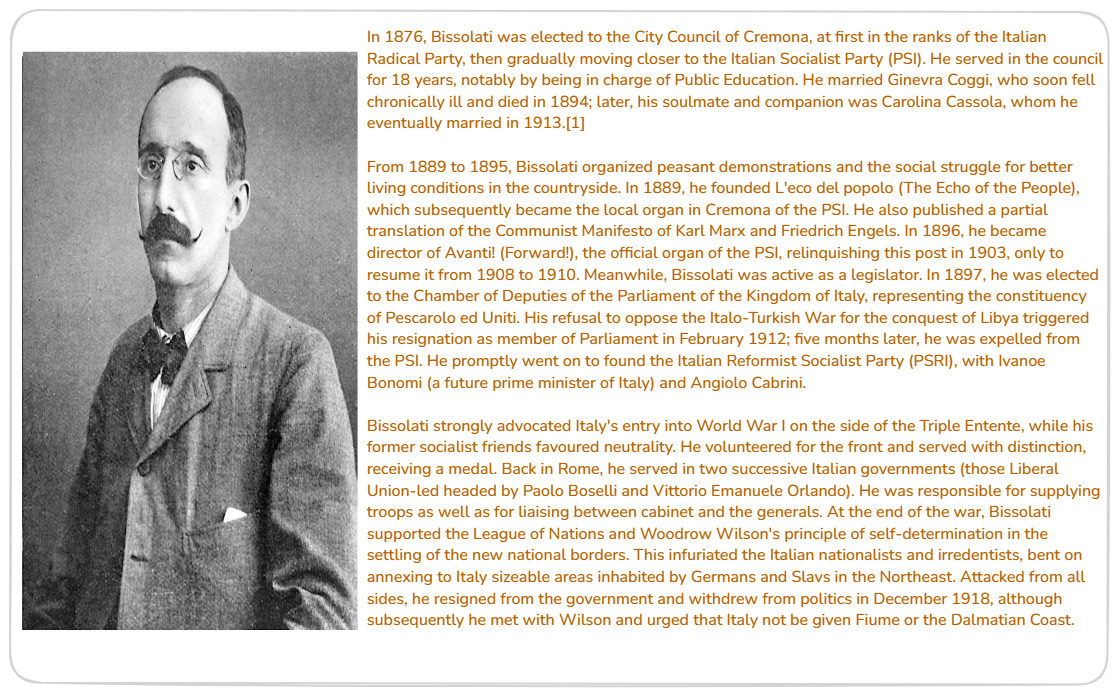
At this point the two disputes took different trajectories. On May 5, Giolitti urged the prefect of Bologna to consult with Leonida Bissolati, a Socialist deputy and the editor of the party newspaper, L’Avanti!. Bissolati urged the prefect to make another attempt to soften the owners. Importantly, the Socialist leader reassured the government that “Order is also close to our hearts because we are convinced that reactionary politics would profit from disorder.” By May 19, Giolitti was convinced that the strike was continuing only because the landowners wanted a pay scale that was lower than in any comparable region. When two strike leaders who had engaged only in peaceful protest were arrested, Bissolati intervened directly with Giolitti: “The neutrality of the government should consist in exercising its power in defense of order only when order is disturbed.” Bissolati assured Giolitti that he did not want to embarrass the government by raising the issue in Parliament.³²
On May 20, Giolitti telegraphed the prefect to stop arresting peaceful women protesters. By May 24, he instructed the prefect to be alert for the possibility of violence, given the increasingly desperate conditions for the workers, and offered Caravaggio additional military force.³³ However, Giolitti rejected Bissolati’s calls to reprimand the prefect. The government was already badly viewed by the landowners, and “It would increase the hostility of the owners toward the government, making any efforts at pacification, even elsewhere, even more difficult.” Later that day, Bissolati wrote to Giolitti in exactly the same language that Giolitti would later use with the prefect of Ferrara: “Please read the telegram from Molinella on the first page of L’Avanti! One dead and many wounded.” And why did not the prefect warn you of such a serious situation?” Bissolati cautioned Giolitti that any bloodshed could set back “the cause of constitutional liberties that you wish to protect.” Despite momentary setbacks, Caravaggio eventually worked out a settlement in Molinella.³⁴
The close coordination between Giolitti and Bissolati was missing in Ferrara. In June 1901 at Berra, soldiers mobilized to overawe the strikers instead fired on a crowd of 500 demonstrators, killing 3 and wounding more than 20. In the eyes of the Socialists, Giolitti’s government was acting like any other in a moment of stress. Publicly, Giolitti defended the conduct of the army, but his wrath was turned on the prefect Salvarezza for having insufficient force at his disposal:
I seriously regret the way you have provided for public security. You did not know how to anticipate and you do not know how to take prudent and energetic measures to guarantee the right to work. In other provinces where the problems were much greater, incidents like this did not happen. I will hold you personally responsible for whatever disorder and any excesses in repression.”³⁵
Responding to an interpellation from Bissolati, Giolitti made clear why he considered situations like the one in Ferrara to be particularly dangerous: large landholdings discouraged small peasant proprietorship and created instead a pool of landless farmworkers; the peasant leagues were weak and less able to control the strikers; the Società delle Bonifiche Ferrarese refused to negotiate and imported labor from outside the area. However, when the strikers invaded the company’s land, the government had no choice but to protect property and maintain order. Giolitti noted with obvious regret that only after the violence did management negotiate.³⁶
Even before the crisis of May and June, conservatives were up in arms against the government for its handling of strikes in Mantua. In defending his policies before the Senate on April 22, 1901, Giolitti agreed that the peasant worker was somewhat better off where he could negotiate informally with the individual landowner, but in areas of large-scale capitalist agriculture, workers had a right to organize. Drawing on the report of prefect Adami Rossi, Giolitti bluntly linked strikes in Mantua with poor wages: “I cannot resist making a comparison between the conditions that produce a result which is deplored by all as a serious danger for public order and the absolute absence of these dangers where the conditions of the working classes are better.”³⁷
The agrarian bloc in the Senate considered the peasant leagues to be a prelude to social revolution and, worse, the government to be a captive of the ninety-six deputies of the Estrema on whose support the Zanardelli ministry depended. Dismissing this latter accusation, Giolitti revealed his long-term strategy of incorporating moderate elements of the left into his liberal majority: “The figure is not exact because on the extreme left many, but many, are within the orbit of the constitution.” A reactionary government would only set back the process of incorporation. But little margin for error existed. Giolitti acknowledged that scab labor made settlement of disputes more difficult and, when imported from a long distance, often cost more than a settlement might have. Nevertheless the government was obligated to defend the right of the landowner to hire whomever he chose.³⁸
The Triumph of the New Course
The debates over the budget of the Interior Ministry in June took place on the fault line of liberal opinion. Sonnino, reluctant to accept Socialist organizations as negotiating partners, accused the government of favoring the workers and called for new rules on arbitration that would limit the right to strike: “To us it seems that the government is not fully aware of its responsibilities and its duties, and that, on the contrary, it prepares sad times for the Patria, subjected as it is to subversive groups.”³⁹
An increasingly confident Giolitti offered a stark choice between his policies and repression. Not the existence of unions but their absence was the problem: “When the working class will be better educated and more organized, it will have less recourse to the strike because it will be better able to judge when a strike will have a favorable outcome and when it will damage the interests of the working class itself.” ==The role of the government was to allow the laws of the market to operate, not to “modify artificially the effects of economic laws that regulate the costs of salaries, as any other merchandise, for the same reason that the government doesn’t intervene when salaries are so low that they do not provide enough to live.”==⁴⁰
The government’s victory was a narrow one, achieved only by the votes of the Estrema. Turati brought over needed Socialist votes in defiance of a mandate on May 29 from the party directorate to refuse general support for the Zanardelli-Giolitti government. When Giolitti’s colleague Ernesto Di Broglio commented that the ministry survived a procedural vote on the budget by only three votes, Giolitti snapped that “it was two more than necessary.” Even the prefect of Turin, Alessandro Guiccioli, certainly no friend of the government, realized the lack of alternatives: “The truth is that in all this discussion the only one who demonstrated daring and the ability of a navigator in the storm has been Giolitti.”⁴¹
Relations with the Socialists
When it came to the Socialist Party, in contrast to the unions, Giolitti was more ambiguous. His definition of the political space available to the Socialists varied according to the circumstances. His exchange of letters and telegrams with Bissolati over the Molinella strike revealed a Giolitti who was more than willing to work with the reformists on a peaceful settlement, but totally unwilling to yield when Bissolati attacked the prefect or questioned the actions of the military.⁴²
If Giolitti needed the Estrema, moderate Socialists and Radicals had little choice but to support his policies. Knowing that the alternative was a return to the politics of repression, and convinced that Giolitti represented an essential step in the modernization of Italy, Bissolati, Turati, and the other reformists cautiously backed the government. The Socialists, according to Turati, were willing to give the government some leeway: “I am of the opinion, and I won over my group to this position, that it would be metaphysical and impolitic to ask today from the government in this Chamber the so-called codification of liberty; but I believe that in compensation it could press somewhat further ahead with the most urgent reforms without danger from within the Chamber and with great advantage to itself in the country.”⁴³ Anna Kuliscioff, Turati’s companion and a major theorist of reformism in Italy, clearly thought that the way was open to further cooperation. She wrote to Turati: “If we want to extract all the profit that Giolitti offers us, there is no more able move than to separate the best of the Socialists parliamentarians from socialism of big words.”⁴⁴
Giolitti certainly encouraged the absorption of moderate Socialists into his majority but only on his own terms. The exchange of telegrams between the prefect of Cuneo, Onorato Germonio, and Giolitti was revealing. The prefect banned all Socialist demonstrations around Racconigi, the summer home of the royal family, and went even further: “I also now seek to block and to abort, by all legal means, proposals for conferences to organize leagues and [the Socialist] party, especially in areas where up to now propaganda has not penetrated and has not gained a foothold. It would be too bad that this province, until today relatively healthy, were spoiled.” ==Giolitti responded a day later: “I approve that you employ all means allowed by the law to thwart Socialist propaganda.”==⁴⁵
Public Sector Strikes
The most severe test for the new course came in early 1902 with a renewed series of strikes in the public service sector. Once again, Giolitti mixed force and conciliation. A strike of gas workers in Turin that lasted more than twenty days was accompanied by a threat of a rail strike. A bit later a strike at the Pignone steel works near Florence became a provincial general strike in the late summer and autumn. Giolitti’s orders to Prefect Guiccioli in Turin, were simple: “in no case was public lighting to be suspended.” Replacement workers would be protected to meet with the strikers, Giolitti ordered the prefect to receive the worker delegation and to play a more active role in ending the strike. Finally, on February 17, Giolitti demanded that the military stop providing protection that evening and that the prefect inform the gas company that its pay scales were lower than those in Milan: “Presence of military was justified to assure public illumination; once assured, it must cease; government cannot smooth the path of the [gas] company, toward which it is necessary that the prefect be very clear.”⁴⁷
No sooner was the gas strike under control than a rail strike threatened. Apart from economic issues, the workers sought to press the case for nationalization of the lines. Giolitti published a notice in the Gazzetta ufficiale on January 25, 1902, that any strike against the railroads would be considered as a public sector strike punishable under the penal code.⁴⁸ In fact, he really wanted to avoid the strike settlement, even if the government had to help meet the demands of the workers. The problem was that Giusso, a conservative ex-mayor of Naples associated with the free-market group, had fought hard in the past for the continuation of private management of the rail lines.⁴⁹ Well before the strike, Giolitti peppered his Radical editor of Il Secolo, who had ties with the rail unions and with Turati, to appeal for restraint on the part of the workers. Romussi seemed sympathetic:
“You have expressed a great truth that the country is less liberal than the government. . . . The Secolo works with its large circulation to educate the country in the exercise of liberty. This education can be done only under a government that respects freedom of information; and for this reason we freely, consciously, support your government.”⁵⁰
By February 22, as a strike loomed, Giolitti arrested the Socialist deputy Oddino Morgari and a day later militarized the railway workers.⁵¹ The threatened rail stoppage came just as the Zanardelli government resigned on February 21 over its failure to elect Tommaso Villa, the ministerial candidate for president of the Chamber of Deputies.== Villa lost when moderates defected over his support for a proposed divorce law. In a calculated gamble, Giolitti urged that power should pass to Sonnino, who was totally ill equipped to take over in the middle of a vast social and political crisis. The king wisely requested that the government return to the Chamber for another vote. Public Works Minister Giusso then resigned, ostensibly over the divorce issue but in reality because he had been superseded by Giolitti. Giolitti then persuaded Zanardelli to finance a settlement with the rail workers: “And now precisely when the government has acted with force by the militarization, it can make a concession without seeming weak.”⁵²
Revealing just how far he still had to go to bring his policies in line with the new course, Sonnino attacked the handling of the strike and dwelled on the dangers of subversion. Giolitti countered with a vision of industrial and economic progress tied to the expansion of education and the inclusion of the working class within state institutions. A just state protected the interests of all classes, including the right to strike except in public services, and the right of nonstrikers to work, and maintained order by bringing contending parties together to facilitate settlements.⁵³
In fact, Giolitti offered little to the Socialists in the way of substantial institutional reform. What he conceded was a controlled space within which the reformist unions and Socialist Party organizations might develop without fear of repression. As long as the Socialists believed that the threat of reaction was so strong as to justify accepting mere toleration, a basis for cooperation was possible. Leading reformists appealed privately to Giolitti to follow a more moderate course so they would not have to embarrass him by raising difficult issues in Parliament. But cooperation was never to be a two-way street. ==Giolitti involved the Socialists in his overall strategy without making any precise concessions.⁵⁴ Turati and his colleagues in the Socialist Party initially enjoyed the access that Giolitti offered them, but they soon understood that the new course meant little more than an expanded role for cooperatives in economic activities, including bank loans to cooperatives and constituency services for Socialist deputies, who came to rely on Giolitti for favors.⁵⁵
The democratic reformer Gaetano Salvemini, Giolitti’s bitter enemy, hoped that the Zanardelli experiment would fail precisely because Giolitti, far more than Sonnino, understood the psychological weaknesses of the democratic movement, which was content to define liberty as “the right to hold meetings, to run around town with the red flag, to hold conferences, to write in newspapers.” The failure to win structural reforms meant that the space offered to the movement by Giolitti implied subordination.⁵⁶ Moreover, Giolitti’s flirtation with the left never precluded the union of all factions of the Liberal Party, including its right wing. Giolitti would not opt for an exclusive alliance with either the Radicals or the Socialists. Turati seemed aware of the ambiguities of the new course. Giolitti, he noted, might qualify as “a wonderful prefect” or “a marvelous brigadier general of the Carabinieri, but he leaves something to be desired in a minister of the interior.” Giolitti maintained order at a relatively cheap price: “Do you believe that you can maintain it for very long? . . . you have maintained order a bit thanks to us.” Turati linked domestic tranquillity and a wider program of reforms; only on that basis could cooperation continue. But this was exactly the basis on which Giolitti did not want to negotiate.⁵⁷
Giolitti, Turati, And Public Sector Organisations
One of the trouble spots of the Giolitti-Turati relationship was unionization of state workers. Turati, the legal adviser for many public sector unions, assisted in the formation of the postal workers’ confederation in 1902 and intervened with Giolitti to protect it from any threat of dissolution.⁵⁸ The movement to organize national and municipal workers had reached an important stage by the beginning of the century; Giolitti even reached out to the Associazione Nazionale degli Impiegati Civili, whose president was the Zanardellian Scipione Ronchetti. Municipal employees received a law to govern their pension funds and a set of standards governing hiring, promotion, and dismissal.⁵⁹ But Giolitti took a cautious attitude toward most civil service union activity, especially when it had Socialist Party overtones. He instructed Prefect Annaratone to watch over an employee of the Justice Ministry who was going to speak at a meeting of state workers in Grosseto, Giolitti asked Justice Minister Francesco Cocco-Ortu for a list of those who participated: “Propaganda among civil servants against the government by an employee seems to me something unbecoming for the government to tolerate.”⁶⁰
The process of organizing state and municipal employees was stimulated by a major achievement of the Zanardelli-Giolitti government, the law on the municipalization of public services that came before the Chamber of Deputies in November 1902. The law expanded the activities of local governments, mainly in the North. From 1903 to 1912, 135 municipalized agencies were created, but only eight were in the South and on the islands.⁶¹ Sonnino and Giolitti both favored the bill, but for different reasons. Sonnino argued that only when a monopoly in public services was likely could municipalization take place, but offered a more expansive perspective. Giolitti, the career state administrator, He compared the records of large industrial corporations that worked with the money of others against publicly run services: “And I believe that if in Italy you take into account how many of the 8,000 communes have administered in an irregular manner and, on the other side, how many banks, corporations have finished badly, probably you would find that the industrial, commercial and banking enterprises represent a percentage of failure and bad administration far higher than the proportion of communes.”⁶²
The New Course and the South
Giolitti’s new course was largely confined to northern Italy in 1901 and 1902. The South represented a different set of problems. The classic view of Giolitti’s treatment of the South was expressed in Antonio Gramsci’s Prison Notebooks, where he described its place in the liberal democratic power bloc as semicolonial, maintained by police measures, the periodic slaughter of peasants, political patronage, and corruption.⁶³ But matters were never so simple. The Zanardelli-Giolitti government was certainly oriented to the North. Only one Southerner held a ministerial position, the unfortunate Giusso at Public Works, who was succeeded by another Southerner, Nicola Balenzano. Giolitti’s Southern allies of 1892 had largely fallen victim to elections run by Francesco Crispi in 1895 and by Luigi Pelloux and Pietro Lacava in 1900. Francesco Girardi, the Neapolitan political boss and deputy from the city’s 4th college, explained to Pietro Rosano that he had been a friend of Giolitti but broke when the latter joined the opposition to Pelloux. Giolitti, Rosano, and Girardi understood the rules, and Girardi would once again become a powerful giolittiano after the 1904 elections. In 1901, however, Girardi still saw little gain in the new government.⁶⁴
Giolitti was out of favor in Naples over a major corruption investigation that was being conducted with Giolitti’s backing by Giuseppe Saredo, president of the Council of State. Saredo examined how huge amounts of money that had been poured into Naples after the cholera epidemic of 1884 managed to disappear without apparent benefit for the city’s poor: “I can attest that almost all the towns in the province of Naples, almost all the charitable organizations [opere pie], are under the authority of criminal associations; I add almost [so as] not to exclude the possibility of some exception.”⁶⁵ Of course the Neapolitan provincial administration, backed by Pietro Rosano, a friend of the least savory elements of the local political elite, tried to block the investigation at every turn.⁶⁶ By September, Saredo wrote to Giolitti for renewed backing to counter rumors (obviously spread by Rosano) that he no longer had Giolitti’s support. Saredo also reported that indictments were being prepared against Rosano’s allies, former mayor of Naples Celestino Summonti and deputy Alberto Casale, who were tied to the Camorra underworld.⁶⁷
Rosano, who viewed Giolitti’s return to office as a chance to regain his seat in parliament from the college of Aversa, aspired to every politician’s dream: to win big, “not an ugly little victory, but a notable victory.” To this end, he needed the neighboring Giuseppe Romano, the deputy and notoriously corrupt boss of the neighboring college of Sessa Aurunca.⁶⁸ Giolitti engaged in a delicate balancing act between Rosano and Saredo. He rejected Rosano’s advice that the commission be limited to an investigation of charities and terminate its investigations in six to eight months. Giolitti also accepted the dissolution of the existing Provincial Council and instructed the prefect, Tommaso Tittoni, to consign prisoners from the Camorra to harsh prison conditions.⁶⁹
Although the Saredo commission continued into 1902, the results were disappointing. In April 1902 Francesco Nitti wrote to Giuseppe Colombo: “In the question of Naples (Saredo can tell you if he had a warmer ally than I) I am particularly in the bad graces of Giolitti, Zanardelli and the so-called democracy, so arrogant and stupid.” Although it was certainly not yet deserved in any way, Nitti told Luigi Albertini that “the present government is sadly the worst for the Mezzogiorno.”⁷⁰ In fact, Giolitti considered the problem of Naples and of the South to be one of deep-seated criminality and backwardness. When the prefect of Catanzaro, Amadeo Nasalli-Rocca, informed Giolitti of a scandal in the city, Giolitti said that the government would press ahead even if it made certain deputies unhappy, because the honesty of local administrations “is the sole means validly to combat the invasion of socialism.”⁷¹
At this point, Giolitti, with little Southern support, showed little inclination to defer to deputies from the region. In the March 15, 1902, vote of confidence over the government’s confrontation with striking railway workers, forty-three Southerners voted with the government but fifty-five against, forming a substantial part of the opposition.⁷² When Paolo Anania De Luca, deputy from Sant’Angelo dei Lombardi, fired off an angry telegram in support of the prefect who had been disciplined by Giolitti because “[m]easures against Prefect Frola insult me” as well as “the interests of the province, morality and the very directives of your government,” Giolitti did not mince words: “I do not accept lessons from anyone. Deputy does his duty as interior minister does his.” When De Luca showed Rosano the telegram from Giolitti, Rosano immediately intervened: “He is still a boy, but, in truth, not a bad boy.”⁷³
Giolitti’s handling of the South changed as his support there grew. Although there were occasional instances when Giolitti sided with the Southern peasantry in 1902, a hardening of position took place during that year.⁷⁴ Already in November 1901, Giolitti instructed the prefect of Trapani, Carlo Panizzardi, to consult with the landowners to find out the extent of the damage they suffered from peasant unrest and to report offenses to the authorities.⁷⁵ Throughout 1902 a distressing number of violent confrontations between soldiers and peasants took place at Cassano Murge, Candela (Foggia), and Giarratana (Ragusa). The pattern continued into 1903 with incidents at Petacciato di Campobasso in February and at Putigliano di Bari in March. Giolitti’s orders to the prefect of Foggia called for the energetic use of force to protect the right of strikebreakers to work. At Candela, where five died and twelve were wounded when an official of the Carabinieri was struck by a rock and began randomly to shoot peasants, a Public Security agent complained that the interior minister did not go far enough: “Damn Giolitti, otherwise at this moment you would be pulverized.” In fact, Giolitti backed the officer who fired. Moreover, he ordered forceful action against the Labor Chamber of Giarratana, where another incident took place.
As he had with the Sicilian Fasci in 1893, ==Giolitti now deliberately criminalized political activity throughout the South.==⁷⁶ During the debates over the Interior Ministry budget in June, Giolitti offered an explicit defense of controlled, top-down social change in a backward region: “We must consider that our peoples are not yet fully educated to a system of liberty; in many places, for example, in some towns in Puglia, the right of assembly is understood in this sense: gather six or seven thousand individuals together, to block by force, workers from other towns from working. Now, obviously no government can tolerate a right of assembly so understood.” Great prudence was necessary in the passage from more restrictive systems: “I confess that mine is truly an empirical policy if by empiricism we mean taking into account the facts, taking into account the real conditions of the country and the people in whose midst we must undertake this domestic policy.”⁷⁷
Later in the year Giolitti again justified different policies in the North and the South: “Propaganda directed at the popular classes needs to be done, taking into account their general moral conditions and their level of education.” A Socialist deputy wondered how Italy could have the right to strike, if it did not have the liberty to agitate for strikes. An unmoved Giolitti contrasted Lombardy, where the peasant leagues controlled their workers and avoided interference with the right of nonstrikers to work, with the peasant leagues at Giarratana and Candela, which through lack of education did not, and lapsed into violence.⁷⁸ When asked why he did not simply support legislation like the English Taff-Vale law, which made unions liable for damages resulting from strike activity, Giolitti stressed the great differences between the two countries. ==England had a politically cultured working class, unions with far more assets, and fewer strikes; in Italy, unions were far poorer and more prone to take risks. Thus, paradoxically, Italy did not need further controls over its unions, but needed to offer them a larger stake in society.⁷⁹ ==An objection from the Socialist Napoleone Colajanni to Giolitti’s use of the power to dissolve local governments, especially in the South, provoked the following exchange:
Colajanni: Certainly these things would not be said in England!
Giolitti: I can also agree that when we have two hundred years of free life, we will be able to do all this freely.
Colajanni: When you gave us the freedom, we did not abuse it! And I praise you for having given us the right to strike, which has produced many fewer inconveniences than the policy of the Whigs.⁸⁰
The Role of the Prefect in the Giolittian System
The prefect remained the vital middleman between the political and bureaucratic apparatus and the “real” Italy. Giolitti turned to the prefect to settle a wide range of disputes and to keep him informed of local situations, especially during elections.⁸¹ Reasons for shifting prefects varied widely. In 1901 Zanardelli received a request from an ex-deputy, Luigi Cavalli, on behalf of his brother-in-law Jacopo Vittorelli, the prefect in Rovigo, who wanted a new post, preferably still in the North. Giolitti’s marginal note stated merely: “Send him to Mantua.” That is where Vittorelli ended up.⁸²
Occasionally, an inept prefect, like Carlo Bacco in Pisa, failed to maintain control of political and social agitation. Bacco allowed security to lapse during a visit of the king, less than a year after the murder of Umberto. Another assassination would have ended Giolitti’s political career. General Ugo Brusati, King Vittorio Emanuele’s aide-de-camp, complained to Giolitti, who fired off a telegram that must certainly have ruined Prefect Bacco’s day: “Such a serious lapse that I cannot but leave the choice for you between unassigned status or retirement.”⁸³ Bacco survived, but remained in Giolitti’s doghouse. In August, Bacco allowed an anticlerical rally to be infiltrated by anarchists who shouted, “Long live Bresci [the assassin of Umberto].” This time Giolitti telegraphed the minister of the royal household that Carlo Bacco had been replaced by Gasperini, the prefect in Massa and “one of the most energetic and intelligent.” Eventually, Bacco was shunted off to Foggia in February 1902, a decided demotion; there he replaced the prefect Benedetto Giustiniani, who, curiously enough, had been removed for failing to protect the right of strikebreakers to work.⁸⁴ The unfortunate Bacco still did not escape Giolitti’s wrath. Disorders by the local peasant leagues led to yet another stinging rebuke: “I see that you do not have the energy necessary to direct a province.”⁸⁵
Giolitti’s abrupt orders to the prefects were designed to show that on questions of public order, a liberal minister could be as severe as a conservative or a military officer. As time went on, Giolitti took on even the most experienced and entrenched prefects if they failed to have enough force available to meet any emergency. In August 1902 Giolitti clashed with the able Antonio Winspeare, a prefect with forty years’ experience, over Winspeare’s handling of the strike in Florence at the Pignone steel works. ==Winspeare miscalculated badly when he assured Giolitti that he could handle the situation with 200 agents and then requested 6,000 soldiers.==⁸⁶
Throughout the Giolittian era the prefects held a wide range of political views, although the majority gradually became giolittiani. Some prefects started out smoothly but abruptly fell from grace. Very early in his career, Amadeo Nasalli-Rocca, at the time subprefect at Saluzzo in Piedmont, was ordered by Giolitti to work against the candidacy of the opposition deputy Achille Plebano. Thereafter he rose steadily from Reggio Calabria in 1903, to Cuneo in 1907, to Venice until 1911; he was abruptly retired in 1913 for allowing a rumor about a cholera epidemic to spread when Giolitti was determined to suppress the information. Other prefects—Angelo Annaratone and Camillo Garroni in the neighboring provinces of Livorno and Genoa—also proved to be extremely sensitive to the new course and rose in Giolitti’s esteem.⁸⁷ In all cases Giolitti made it clear that he expected orders to be followed. The prefect of Reggio Calabria was told that if he continued to favor the opposition, he would be fired: “I cannot admit that to favor the political party hostile to the government you fight the president of the provincial deputation.”⁸⁸ In the case of a subprefect in the province of Cosenza, Giolitti complained that he “put himself entirely at the service of the party in opposition to the government: Call him and tell him that if he continues along such a route, I will demote him immediately from the post of counselor, reassigning him to a worse post. I do not tolerate traitors.”⁸⁹
Legislative Achievements
The Zanardelli government is largely remembered for inaugurating Giolitti’s new course in domestic policy, but its legislative record was weak on major reforms. For two decades Giolitti had complained about the need for tax reform and cuts in the military budget. A commitment by Giolitti to such a program would have provided a durable basis for cooperation with the Radicals and Socialists. When Finance Minister Leone Wollemborg proposed a major overhaul of the fiscal system, the project ran into trouble in the Chamber of Deputies and was rejected by the cabinet on July 29, 1901, leading to Wollemborg’s resignation a week later. Thereafter the government avoided conflict with the conservatives by opting for debt conversion as a way of producing more revenue.⁹⁰
Giolitti’s views on a rural housing and sanitation bill probably best expressed his limited and gradualist vision of reform: “Certainly the conditions of rural housing in the greater part of Italy are so deplorable and, let us say it frankly, so shameful that it is not possible to presume that in such a short time and with these limited means one can remedy everything.” He went on to say that he would “be happy if within a half century all Italy would have decent rural housing.”⁹¹
Nonetheless, a number of important and useful initiatives were passed: worker insurance (except for agricultural workers), a minor reform to set the minimum age for children in industrial occupations at twelve years, new measures for emigration, special laws for Basilicata and for Naples, the reform of charitable organizations, more money for teachers, municipalization of communal services, and increased opportunities for cooperatives to bid on government contracts. The National Labor Office and the Superior Council of Labor were established. The latter was a consultative body of delegates from various ministries, nominees of the government, and elected representatives that could recommend reforms and discuss legislation submitted to it by the government. The National Labor Office, the nucleus of the future Labor Ministry, was placed under the direction of Turati’s friend Giovanni Montemartini, an example of the range of favors that Giolitti was willing to offer to cooperative Socialists.⁹²
Giolitti, Divorce, and the Clerical vote
The Vatican’s Osservatore romano was initially skeptical about Giolitti’s new course in domestic politics. Strikes, the Osservatore romano argued, were legitimate only in extreme and rare cases. The Vatican paper argued two closely related points. Most obviously, the Catholic Church opposed the growing strength of the Socialist Party. But the rise of socialism offered new possibilities. As liberal hegemony collapsed, the need for clerical support increased. The clerical press devoted much attention to the inability of the liberal political class to offer a coherent alternative to socialism. Thus, Giolitti’s success in stabilizing the liberal state was a mixed blessing for the Osservatore romano, which insisted that the calm was merely illusory.⁹³
Relations between Giolitti and the clericals improved as the interior minister differentiated himself from Zanardelli on church-state relations. In May 1901, when Bishop Sabatino Giani of Livorno refused to participate in a ceremony marking the anniversary of the death of Umberto, Giolitti worked closely with Annaratone to minimize the incident. A few months later Giolitti again muted a possible conflict with the church when the same bishop shouted “Rome or Death!” at a Catholic congress. A report of Public Security inspector Raffaello Orso dismissed the bishop’s remarks as mere rhetoric. Giolitti agreed, but told Prefect Annaratone to have the bishop avoid future incidents.⁹⁴
The defining issue was divorce. Zanardelli presented his first bill for legalized divorce in 1883, and it was assumed that he would press for a new measure now that he was prime minister. Giolitti considered divorce to be just the type of issue that might mobilize the clerical forces. His motivations for opposing divorce were tactical and political, but whatever the motivation, he presented a different political profile to the Catholics.⁹⁵
After a delay due to the debates over the strike wave and the budget, the Socialist Agostino Berenini and the Radical Alberto Borciani introduced a divorce bill on December 6, 1901. The Berenini-Borciani draft allowed divorce in cases of imprisonment for more than ten years, mental problems with no hope of remedy after three years, perpetual impotence, and legal separation after three years if no children were involved or after five years with children. A government alternative, introduced on February 20, 1902, allowed divorce only in cases of legal separation for adultery, voluntary abandonment, severe physical violence, and prolonged imprisonment.⁹⁶
Giolitti distanced himself from the issue, and the Catholic press immediately speculated on divergences within the government. The Osservatore cattolico correctly reported that Giulio Prinetti and Giolitti both opposed the government’s bill. The Cittadino di Brescia observed that Giolitti was the chief obstacle to divorce within the government but that the conservatives, fearing Giolitti’s growing political strength, did not want him to emerge victorious over Zanardelli.⁹⁷
Zanardelli and Giolitti: Toward a rupture
The relationship between Zanardelli and Giolitti had never been an easy one, and it was not helped by a secondary conflict between Giolitti and Nunzio Nasi, a rising star in the Zanardellian camp, who had been appointed minister of public instruction and was seen as a possible successor to Zanardelli as leader of the liberal left. Rosano noted that Nasi had supported efforts by Sonnino to split Zanardelli from Giolitti in 1901: “The Zanardellians fear that Zanardelli may die and they much prefer to have Rudinì over you.”⁹⁸ Giolitti attacked Nasi over a minor reform of the system of high school examinations, almost defying the Zanardellians to break with him. He demanded that Zanardelli immediately revoke the decree and then intervened with the Corte dei Conti so that it would neither be registered nor take effect.⁹⁹
By the beginning of 1903 the Zanardelli-Giolitti alliance was on its last legs. The declining health of Foreign Minister Prinetti, forced to leave office in January 1903, posed problems of succession. In February and March, Giolitti was absent from parliament. Officially, he was listed as ill, but rumors spread of disagreements over divorce and other issues.¹⁰⁰ Debate on the divorce bill at the end of 1902 revived Catholic opposition. The presence of Emanuele Gianturco, a close ally of Giolitti, in the leadership of the National Anti-Divorce Federation indicated that the interior minister did not accept the government’s position. In early 1903 Giolitti told Zanardelli that a majority of the Piedmontese deputation would oppose the bill. In any case it was a dead issue. ==As soon as it was introduced, it was beaten in committee.¹⁰¹
In March, Zanardelli reached out unsuccessfully to Luigi Luzzatti to replace Treasury Minister Di Broglio. At the end of March the Socialists broke with the government, in part over Giolitti’s defense of the government’s repression of peasant protests at Candela and Putignano. La Stampa commented that “the ministry without the votes of the Estrema Left cannot live a single day.”¹⁰² The end came in June 1903. In late May, fighting broke out between German and Italian students at the University of Innsbruck in Austria. Giolitti, never sympathetic to irredentism, ordered the prefects to clamp down hard on anti-Austrian protests. He also demanded that Public Instruction Minister Nasi stop any demonstrations at the universities and secondary schools.¹⁰³ When one prefect, Felice Reichlin in Piacenza, thanked the demonstrators instead of sending them packing, Giolitti promptly suspended him. Reichlin appealed to Zanardelli, who asked Giolitti at least to wait for the prefect’s explanation. Giolitti responded abruptly: “The conduct of Prefect Reichlin was so wrong that I invited him to ponder whether he believed he could remain in his office as prefect. He responded that he was disposed to request retirement, and I replied that he did well to do so before I brought the question to the Council of Ministers.”¹⁰⁴
At war with several colleagues and unhappy with important policy decisions, Giolitti resigned on June 11, 1903. Clearly, he felt that the government had simply run out of gas. Its parliamentary base gone with the defection of the Socialists and part of the Radicals, the ministry could neither face the Chamber of Deputies nor go to the country confident that it would win the elections. Maliciously, Giolitti suggested that Sonnino might take his turn in power. The idea of allowing the conservatives to return to office to run elections terrified the Radicals.¹⁰⁵ Zanardelli reached out to Rudinì and to Luzzatti on the right, and to Giuseppe Marcora on the left, to save his government. The two conservatives seemed more than willing to join, but Giolitti was equally determined to use his faction to stop the alliance with the right and to block immediate elections. Zanardelli limped along, hoping that the summer recess would allow time to complete the negotiations with Marcora for the entry of the Radicals into the government.¹⁰⁶ But Zanardelli was too weak to pull it off. Raffaele Cappelli, former foreign minister under Rudinì, wrote to his friend Cesare Fani: “Zanardelli is sick and weary; binding oneself to him is like tying up with a cadaver. . . . It is useless, my dear Fani, to create illusions. The strong man in the country and in Parliament today is Giolitti. Can one form a ministry without him?”¹⁰⁷ By autumn a frustrated Rudinì wrote to Luzzatti: “Zanardelli, you say, is in bad shape. I wish him a long life, very long, because I fear the successor.”¹⁰⁸
Giolitti’s experience in the Zanardelli government had been important for two reasons. Above all, he convinced conservatives that the new course did not mean anarchy or the triumph of socialism. Second was Giolitti’s opening to the Catholics. He now stood out as a man of a different left. But, although the opening to the Socialists is usually seen as a great gain in these years, Giolitti’s return to office revealed his underlying problems with the reformists. By the end of the Zanardelli government, the Socialists were frustrated with the experiment. For their own reasons, Turati, Kuliscioff, and Morgari blamed Zanardelli for the failures, but it was clear after two years that Giolitti’s priorities did not include major rewards for the Socialists.¹⁰⁹
Summary
Formation of the Government (February 1901)
- February 1901: Zanardelli forms a government with Giolitti as Interior Minister. This marked the beginning of the "new course" in Italian politics.
- The government was a coalition of liberal left and moderate factions (Giolittians + Zanardellians), with some conservative participation (e.g., Giulio Prinetti as Foreign Minister).
- Support came from the Estrema (Filippo Turati brought Socialist backing on Feb 4) and token opposition from moderates like Rudinì and Luzzatti.
- Giolitti emerged as the real driving force, more dynamic than the elderly Zanardelli.
The Strike Wave of 1901 – Symbol of the New Course
- 1901: Massive strike wave — 1,671 strikes involving 420,000 workers (vs. 410 strikes / 43,000 workers in 1900). Highest strike activity in Europe for 1901–1914.
- Giolitti’s balanced approach:
- Neutrality in peaceful private-sector strikes (no automatic troop deployment; protection for non-strikers and public services).
- Strong repression when violence or public services were threatened (replacement workers, expulsions, militarization).
- Mediation and early concessions in private disputes; use of prefects as key agents.
- Force when necessary, but aimed at de-politicizing labor by addressing economic grievances.
Agricultural strikes were especially dangerous due to landowner influence and rural poverty. Giolitti used overwhelming force but preferred mediation where possible.
Relations with Socialists & the Left
- Giolitti offered controlled tolerance and co-optation of moderate Socialists/reformists (Turati, Bissolati, Kuliscioff) as subordinate partners.
- He encouraged absorption of moderate elements into his majority on his own terms, without major institutional reforms.
- Socialists provided crucial parliamentary support but grew frustrated by the lack of deeper concessions.
Public Sector Strikes & Challenges (1902)
- Early 1902: Serious strikes in gas, rail, and other public services.
- Giolitti combined force (militarization of rail workers) with targeted concessions.
- February 1902: Gas strike in Turin; rail strike threat.
- Government survived budget votes narrowly thanks to Estrema support.
Relations with Catholics & the Church
- Giolitti distanced himself from Zanardelli’s anti-clericalism and opposed divorce legislation (tactically and politically).
- Improved relations with clerical forces through pragmatic openings and opposition to divisive issues like divorce.
The South
- The new course was largely northern-focused.
- South seen by Giolitti as plagued by criminality, backwardness, and corruption (e.g., Saredo inquiry in Naples).
- Giolitti used strong prefectural control and force against disorder, while slowly rebuilding southern alliances.
Legislative Record & Limitations
- Weak on major structural reforms (tax, military budget).
- Notable achievements: worker insurance, child labor minimum age, emigration measures, municipalization of services, cooperative support.
- Rural housing/sanitation bill reflected Giolitti’s gradualist philosophy.
End of the Government & Rupture (1903)
- June 11, 1903: Giolitti resigned amid conflicts (especially with Nasi) and weakening support.
- Zanardelli government collapsed shortly after; Giolitti positioned himself as the indispensable leader.
Overall Assessment: The Zanardelli-Giolitti government (1901–1903) established the foundations of Giolittian pragmatism — a mix of order, limited social opening to moderates/unions, co-optation of rivals, and strong executive control through prefects. It stabilized Italy after the crises of the 1890s but highlighted Giolitti’s preference for controlled, top-down modernization over radical reform.
Chapter 5: Giolitti's Second Ministry: Doing it "Right", 1903-1905